

A Project keeps your searches, Perplexity Computer tasks, files, instructions, and connected tools together so you and your collaborators can return to the same work over time.
Creating a Project
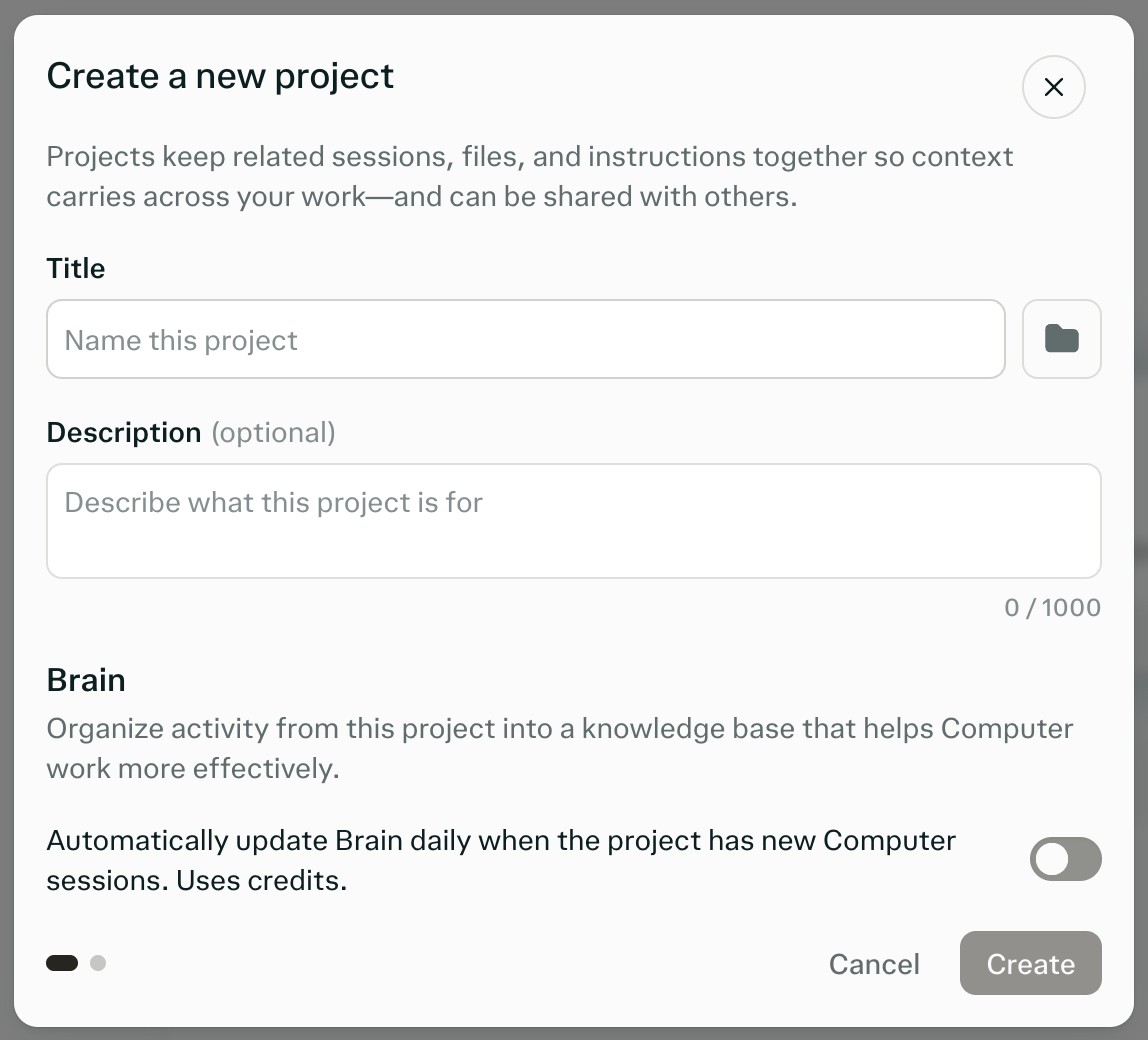
Select the Projects section in the left sidebar to open your projects menu, then select New project. You can also select the plus icon that appears when you hover over the Projects header.
Give your Project a title (up to 50 characters), an optional description (up to 1,000 characters), and an optional icon and color to make it easy to recognize.
After you create the Project, add instructions (up to 8,000 characters) in its settings to tell Computer how to work inside this Project. For example, you can set a preferred response format or a status file to keep updated.
Choose who to share with. Projects are private by default: Only people with access can view.
You can also start a Project from an existing session, and Perplexity will suggest a title, description, and instructions based on it. In a Computer task, use Convert session to project to create a Project and carry your files and artifacts into it. You can also ask Computer to create a Project from one or more existing sessions.
There’s no limit on how many Projects you can create.
Collaboration and sharing
Select the list of project members at the top right of a Project, or the Share button, to manage access and sharing permissions.
Roles
Owner — full control. Some settings are owner-only: automatic Brain updates, the project summary, personal memory, and approving requests to join.
Can edit — edit context, files, connectors, skills, people, defaults, and channels.
Can view — read the Project and its shared sessions and files.
Access scopes
Only people with access can view — invited people only. This is the default, and the only option on personal accounts.
Anyone in [your organization] with access can view — Enterprise plans only.
Anyone in [your organization] with access can edit — Enterprise plans only.
Projects cannot be made publicly queryable. Owners and editors can invite people or, on Enterprise plans, share access within their organization.
People with view-only access see You have view-only access and can select Request edit access. People who open a Project without access see that the Project is private, with a way to request access or contact the owner. The owner approves or denies requests under Requests to edit.
On Enterprise plans, organization-wide sharing scopes are available, and administrators can restrict external invites and organization-wide publishing. See Enterprise roles and permissions.
Contributor limits
A Project can have up to 5 contributors. If the Project’s owner belongs to an organization or is a verified student or educator, the limit is 9,999.
The owner doesn’t count toward the limit, but pending invitations do, and people you invite as viewers count alongside editors.
Sharing a Project with your whole organization, instead of inviting people one at a time, doesn’t count toward this limit.
If a Project reaches its limit, Perplexity tells you the Project has reached the maximum number of contributors. Cancel a pending invitation or remove a contributor to free up a place.
Project files
Each Project has access to Files. You can upload persistent files individually or as folders, and add files from connected sources to serve as context in a Project. Computer can also create, update, and manage files on your behalf.
Files in a Project are shared with project members who have the appropriate permissions. Viewers and editors can view files, but only editors can edit, delete, or upload files.
Project file limits
Every Project holds up to 10,000 files and 5 GB of total storage, with each file up to 100 MB. These limits are the same for everyone, on every plan, and there is no restriction on file type.
To see what a Project is using, open its settings and go to the Context page. The Files section shows Files saved and Storage used. If your Project uses the new layout, go to Sources > Files in Project settings instead, then select Project file usage from the Project files actions (⋯) menu. See Project settings for how to open settings.
For the limits that apply to sessions and organization files, see Enterprise file limits.
Files added from connectors
Files you add from a connected source are one-time copies. If you update or delete the original in the connected app, the copy in your Project does not change.
To work from current content, ask Perplexity to fetch the latest version through the connector, or add the file again.
Brain
Brain builds ongoing memory for all work done in a Project. You can view the current memory in the Brain tab, or under Sources > Brain in Project settings if your Project uses the new layout.
Automatic Brain updates use the Project owner’s credits. Running an update yourself (Update now, or Update Brain now in the new layout) uses your own credits. You can control whether Brain updates automatically in the Memory settings.
Project settings
The steps to open Project settings are the same on personal accounts and Enterprise plans, but some options differ, and some personal accounts have a new Project layout. Owners and editors can change most settings. Some are owner-only; see Roles.
Project settings for personal accounts
Open the Project.
Select the Settings tab.
Select a settings page: Context, Memory, Apps, Connectors, or Skills.
Perplexity is rolling out a new Project layout to personal accounts. If your Project shows a See all settings button in the panel on the right, select it to open Project settings. If the panel is hidden, select the settings icon (Configure project) at the top right of the Project first. In the new layout, sections include General, Members, Sources, Memory, Integrations, Connectors, Skills, and Credential vault.
On personal accounts, Projects are always private, so there are no organization access options. Once a Project has other members, it can’t use members’ personal memory.
Project settings for Enterprise organizations
Open the Project.
Select the Settings tab.
Select a settings page: Context, Memory, Apps, Connectors, or Skills.
On Enterprise plans, you can also share a Project with your organization; see Access scopes. Personal memory can be used in shared Projects unless your organization’s memory settings don’t allow it.
Context
Add and manage instructions used for every query run in the Project.
Add and manage web links and domains to prioritize.
Manage the default mode, Search or Computer, and set a default Computer orchestrator model.
See the Project’s files saved and storage used against its limits.
In the new layout, instructions and defaults are under General, and files and links are under Sources.
Memory
Turn Brain on or off and choose automatic or manual runs. The owner controls Automatically update Brain (Update automatically in the new layout).
Enable and manage project summary settings. Project summary generates a running status update of the work done in a Project.
Control whether queries in the Project can draw from the personal memory of the person who started the session, with Use session creator’s memory (Personal memory in the new layout). This setting is on by default and only the owner can change it. On personal accounts, it’s turned off and can’t be changed once the Project has other members.
Slack and Microsoft Teams
On the Apps page (Integrations in the new layout), bind Slack or Microsoft Teams channels to the Project. Context from those channels is then included in project context, and any Computer queries submitted in those channels appear in the Project’s session history.
Connectors
Choose which connectors the Project uses and add connector-specific instructions.
Add shared project-level credentials. In the new layout, these are under Credential vault.
Project-level credentials cover custom API credentials, such as a bearer token or API key added for Computer. They do not cover Microsoft 365 or other connector sign-ins.
Skills
Upload and manage reusable skills scoped to the Project. Personal and organization skills remain available inside a Project as well.
Files
See the Project’s current file count and total storage on the Context page, or with Project file usage under Sources > Files in the new layout. See Project file limits.
Organizing your Projects
Pin important Projects for quick access. Pinned Projects appear on the project overview page and in the Projects section of the left sidebar.